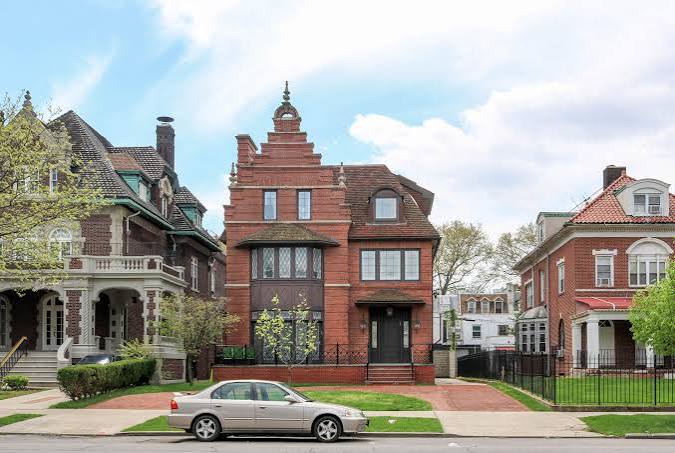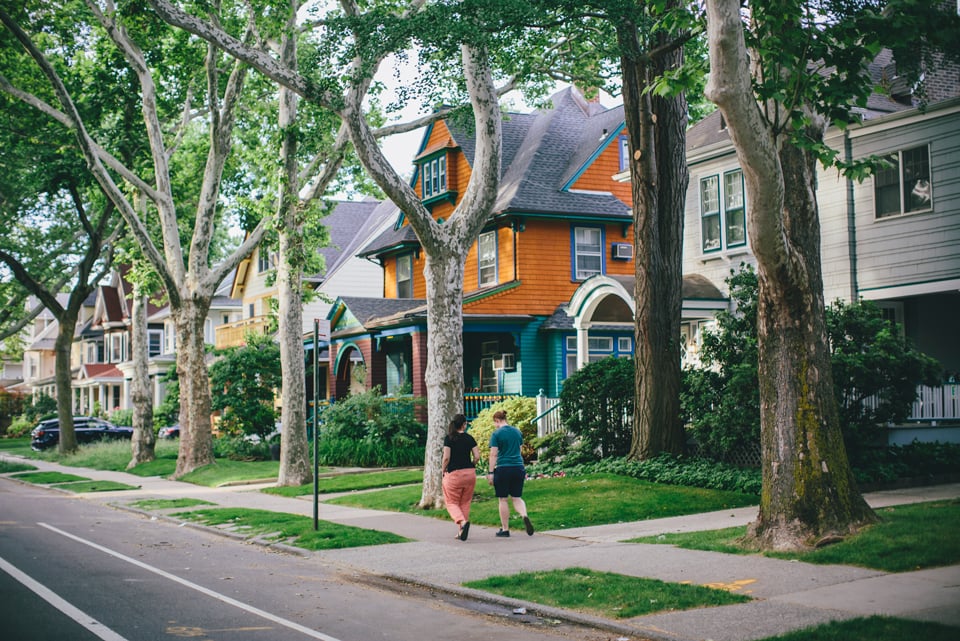
What is Ditmas Park like for buyers? Picture a street of freestanding wooden houses with wrap-around porches, driveways, lawns, and hundred-year-old trees meeting overhead, then remember you're eleven stops from Manhattan on a train that runs all night. That's the pitch, and it isn't a metaphor. These are detached single-family houses with side yards, in Brooklyn, at scale.
The whole thing was built on purpose, and quickly. Between about 1899 and 1914, a handful of developers bought Flatbush farmland and laid out landscaped suburbs with underground utilities, planted medians, and deed restrictions requiring one-family houses. What they produced is the largest concentration of freestanding Victorian and Edwardian houses in New York City, and most of it still looks the way it did when the last one went up.
Here's what changed recently, and it matters more than anything else on this page: in November 2025 the Landmarks Preservation Commission designated two more historic districts here, bringing the total to five. If you're reading a guide that says three, it's out of date, and if you're about to buy a house whose renovation rules you think you understand, check the map again. This guide walks the current version: the districts and what they actually restrict, the four pockets, what a wood-frame house asks of an owner, and how to buy well on either side of a landmark boundary.
In this guide
- The lay of the land: what defines Victorian Flatbush
- The landmark map just changed
- Quick comparison: the four pockets at a glance
- Which pocket is right for you?
- Victorians, bungalows, and pre-war co-ops: the housing ladder
- What a wood-frame Victorian actually asks of you
- What drives value in Ditmas Park and Flatbush
- Cortelyou, Newkirk Plaza, and the corridors
- The commute, honestly
- The four pockets, up close
- The Rahmé Team Victorian Flatbush market read
- Buying strategy: how to actually win here
- Living here day to day
- How to choose
- FAQs
- Work with a local team

Fouad Rahmé
Founder, the Rahmé Team at Compass
The Rahmé Team advises buyers, sellers, investors, and developers across Brooklyn, with 40 years of combined experience, more than 1,000 clients and transactions, and over $800 million in career sales, $167 million of it since 2020. RealTrends Verified ranks the team in the top 1.5% of real estate professionals nationwide.
Contact the team or call (718) 233-3365.
The lay of the land: what defines Victorian Flatbush
Start with three developers and about fifteen years. In 1899 Dean Alvord bought roughly 60 acres of Flatbush farmland and laid out Prospect Park South as what he called rus in urbe, the country in the city, hiring a Scottish landscape gardener named John Aitkin who planted trees at the curb line and again at the building line so the streets would read wider than they were. That canopy is Aitkin's, still doing its job 125 years later.
Then Lewis H. Pounds. In 1902 he and his Manor Realty Company bought the old Ditmas farm, which straddled the Brighton railroad, and built out the eastern half as Ditmas Park. A year later he started on the western half and called it Ditmas Park West. His deeds required one-family houses and set standards for construction, the same instinct that produced Lefferts Manor across the park, and it's why these blocks never converted to rooming houses. In 1905 T. B. Ackerson did the same thing further south with Fiske Terrace, and a few years earlier he'd had the numbered streets renamed Argyle, Rugby, and Marlborough to match the English road names in Prospect Park South. That's why your GPS gets confused down here.
The umbrella term Victorian Flatbush came much later, and it's loose: it covers Prospect Park South, Ditmas Park and Ditmas Park West, Beverley Square East and West, Fiske Terrace, Midwood Park, West Midwood, South Midwood, and a few more. The rough footprint runs from Prospect Park's southern edge down toward Brooklyn College, between Coney Island Avenue and Ocean or Flatbush Avenue depending on who's drawing. The Brighton line runs straight down the middle of it in an open cut, which is the single most useful thing to know about the geography.
The landmark map just changed
On November 25, 2025 the Landmarks Preservation Commission designated two new historic districts in Flatbush, and the local map now reads like this:
- Prospect Park South, designated 1979, the grand blocks off Albemarle Road
- Ditmas Park, designated 1981, roughly ten blocks and 172 buildings put up between 1902 and 1914
- Fiske Terrace-Midwood Park, designated 2008, the southern end around Avenue H
- Beverley Square West, designated 2025, 118 houses built 1894 to 1910 on three blocks between Beverley and Cortelyou Roads, most of them by Brooklyn architects like John J. Petit, John B. Slee, and Benjamin Driesler
- Ditmas Park West, designated 2025, 127 houses built mostly 1902 to 1910 between Dorchester Road and Ditmas Avenue, nearly half of them by a single architect, Arlington D. Isham
Two things follow for a buyer. First, roughly 245 houses that were unregulated in 2024 now answer to the commission on exterior work, so any renovation math you did on those blocks before last winter needs redoing. Second, and this is the part people miss, the commission deliberately held the boundaries tight. Residents asked for Westminster Road, Stratford Road, and parts of Beverley Road to be included, and staff said no on the grounds that those blocks showed higher rates of alteration. So you now have unlandmarked streets sitting directly beside landmarked ones, with near-identical houses on them and completely different rulebooks. The commission left the door open to smaller districts later.
Which means the first question about any house here isn't the kitchen. It's which side of a line it's on, and whether that line moved.
Quick comparison: the four pockets at a glance
The Brighton cut and the district boundaries do more sorting here than the avenues do. Here's the shape of it.
The feel | Housing stock | The rulebook | Transit | Best if | |
|---|---|---|---|---|---|
Prospect Park South | The grandest blocks, closest to the park | Large freestanding houses on the widest lots, Albemarle and Buckingham | Landmarked since 1979 | Church Avenue, with weekday B express service | You want the biggest house and the shortest walk to Prospect Park |
Ditmas Park and Ditmas Park West | The archetype, porches and deep front lawns | Queen Anne, Colonial Revival, Tudor, and one of the country's better rows of Craftsman bungalows | Landmarked, the eastern half since 1981 and the western half since 2025 | Cortelyou Road and Newkirk Plaza | You want the classic version and accept commission review to protect it |
Beverley Square, Fiske Terrace, and the southern blocks | Quieter, further from the strip, a mixed regulatory map | Same house types, more variation in condition and alteration | Landmarked in patches; check block by block | Beverley Road, Newkirk Plaza, and Avenue H | You want renovation latitude, or the same house for less |
The corridors | Ocean, Church, Flatbush, and the Cortelyou strip | Pre-war elevator co-ops, mid-rise apartments, some condos | Board rules rather than commission rules | On top of the stations, plus the Flatbush and Ocean bus lines | You want pre-war space at the neighborhood's entry price |
Which pocket is right for you?
Ask one question first: are you buying a house or a project? If it's a house, in reasonable shape, that you intend to live in and maintain, the landmarked blocks are working in your favor. Commission review is why the street still looks like this, why your neighbor can't wrap their porch in vinyl, and why the value of the whole streetscape holds. You'll wait longer for approvals and you'll spend more on the right windows. That's the deal, and most people here think it's a good one.
If it's a project, or if you have strong ideas about a rear extension and a modern kitchen behind an original facade, look hard at the unlandmarked blocks. Same architects in a lot of cases, same era, same lot sizes, and a permit path that runs through the Department of Buildings rather than a commission. And if the house itself is less important than the pre-war space and the commute, the co-ops along Ocean Avenue and the corridors are the entry lane and always have been.
Victorians, bungalows, and pre-war co-ops: the housing ladder
The freestanding houses are the reason anyone comes here. Queen Anne with the asymmetrical towers and the wrap-around porches, Colonial Revival with the columns and the Palladian windows, Shingle Style, Tudor Revival with the half-timbering, and a run of Craftsman bungalows in Ditmas Park that preservationists rate among the best on the East Coast. Wood frame, mostly, on lots with real setbacks, and a good number with driveways and detached garages. The layouts inside are what you'd expect from houses built for one family and never chopped up: entry halls, pocket doors, staircases with landings, bedrooms on two upper floors, and finished attics that people turn into offices.
Semi-detached and attached houses fill in around the edges, along with the occasional row on the blocks nearer the avenues, and prices there sit meaningfully below the freestanding stock for the same square footage. Worth knowing if the porch matters more than the side yard.
The pre-war co-ops carry the entry lane. Ocean Avenue and Church Avenue hold elevator buildings with the proportions that stopped getting built after the war, real foyers, separate dining rooms, decent light, and boards that run the full spectrum from formal to relaxed. Expect a package, financial statements, and an interview as the baseline. Per square foot, these are some of the better values in Brooklyn, which is exactly why we walk buyers through the board's expectations before anyone falls for a floor plan.
What a wood-frame Victorian actually asks of you
Here's the part the pretty photos skip. A hundred-and-twenty-year-old wooden house is a fundamentally different maintenance animal from a brownstone, and the costs are real, recurring, and worth pricing with your own inspector before you bid rather than discovering in year two. The categories that matter most:
- The envelope. Wood siding and shingle need paint on a cycle, and the cycle is shorter than owners hope. Deferred paint is not cosmetic; it's how water gets into the frame.
- The porch. Columns, decking, roof, and drainage. Porches are the first thing to go on these houses because they take the most weather and sit closest to the ground, and in a historic district the repair has to match.
- Roofs and rooflines. Turrets, dormers, and multiple gables mean a lot of flashing and a lot of valleys. Complicated rooflines cost more to redo than simple ones, every time.
- Windows. Original single-glazed wood sashes, often dozens of them. In a landmarked district, replacement is regulated and the compliant option is not the cheap one. Storm windows and restoration are usually the smarter path anyway.
- Systems and framing. Balloon framing makes insulation and air sealing much harder. Ask the age of every system, ask about knob-and-tube remnants, and ask specifically whether there's a buried oil tank on the property, because that's an expensive surprise and a common one on lots this old.
- Wood-boring insects and ground contact. Any wood structure this age wants a termite inspection, not an optional one.
- Insurance. Carriers price wood-frame construction differently from masonry. Get an actual quote before you're in contract, not an estimate afterward.
None of that is a reason not to buy one. It's a reason to buy one with your eyes open, budget the first three years honestly, and find an inspector who has actually worked on these houses rather than one who mostly does condos.
What drives value in Ditmas Park and Flatbush
Lot and house together do the fundamental pricing, and the variables are physical: frontage, setback, whether the house is freestanding or touching, whether there's a driveway and a garage, and how much of the original detail survived. Off-street parking carries a premium here the way it does everywhere in Brooklyn, and the difference between a wide corner lot and a standard one shows up immediately in the comps.
Condition splits the market more sharply than location does. A house with a recent roof, updated systems, and a restored porch trades in a completely different bracket from an identical house on the same block wearing forty-year-old mechanicals and a paint job from the Bush administration. That spread is wider here than in masonry neighborhoods, because the deferred maintenance bill on wood frame is larger and everybody knows it.
And then the paperwork. Whether a house sits inside a historic district, and which one, changes the renovation calculus and therefore the price. Post-2025, that's a live question on blocks where it wasn't before. Legal use matters too: many of these houses were built and deeded as single-family, some were later converted, and whether the Certificate of Occupancy matches what you're being shown is a question worth asking on day one rather than at the closing table.
Cortelyou, Newkirk Plaza, and the corridors
Cortelyou Road is where the neighborhood eats and runs into itself. Cafes, a food co-op, restaurants people cross the borough for, a farmers market, and a stretch of storefronts that has managed to stay interesting without becoming a theme park. Saturday mornings on Cortelyou are the neighborhood at its most itself.
Newkirk Plaza is the local oddity worth knowing about: a pedestrian shopping plaza built directly over the open subway cut, opened in 1913 and renamed in 2011, with shops on both sides of a walkway and trains running underneath. There is nothing else quite like it in the city. Church Avenue and Flatbush Avenue handle the bigger everyday retail, and Ocean Avenue runs the eastern edge with its apartment buildings and its own bus service.
The green here isn't parkland so much as canopy. Aitkin's double rows of street trees, the planted center medians on the Flatbush malls, and front lawns on nearly every block add up to more shade than most of Brooklyn manages, and Prospect Park itself sits at the northern edge, a short bike or bus ride from most addresses. In October these streets are the best-looking blocks in the borough. That isn't a marketing line, it's just true, and people drive here to see it.
The commute, honestly
The Brighton line runs down the middle of the neighborhood in an open cut, and the service split is the thing to understand. The Q runs at all times on the local track and stops at Beverley Road, Cortelyou Road, Newkirk Plaza, and Avenue H. The B runs weekdays only on the express track and stops at Church Avenue and Newkirk Plaza but not at the local stations. So a Newkirk Plaza address gets both trains, a Cortelyou address gets one, and that difference is worth actual money over a thirty-year hold.
A local quirk: Beverley Road and Cortelyou Road are the two closest stations in the entire subway system, about 500 feet apart. If your block sits between them you effectively have two entrances to the same line. Avenue H is worth seeing regardless of whether you buy near it, since the station house is a landmarked 1900s wooden building that started life as T. B. Ackerson's real estate office for Fiske Terrace, selling the houses the train now serves.
Driving is easier than most of Brooklyn. Street parking is actually findable on the residential blocks, a lot of houses have driveways, and Coney Island Avenue and Ocean Parkway get you south and out quickly. Getting to Downtown Brooklyn or north Brooklyn takes longer than people expect, though, since almost everything routes through the Brighton line first.
The four pockets, up close
Prospect Park South holds the grandest houses in the neighborhood and some of the grandest in the borough, on Albemarle, Buckingham, and the surrounding blocks. Alvord built it to be looked at, and it is. Landmarked since 1979, closest to Prospect Park, and served by Church Avenue with the weekday express, it trades rarely and at the top of the local market.
Ditmas Park and Ditmas Park West are the archetype and, since last November, both landmarked. Porches, deep lawns, the Craftsman bungalow row, and the Cortelyou strip a few blocks away. The western half is the interesting story right now: 127 houses that went from unregulated to protected in one vote, nearly half of them designed by the same architect, which is why the streetscape reads so cohesively.
Beverley Square, Fiske Terrace, Midwood Park, and the southern blocks give you the same house types with a patchier regulatory map. Beverley Square West is now landmarked, its neighbors partly are not, and the LPC was explicit that the excluded blocks showed more alteration. That means more variation in what you'll see and more room to negotiate on condition, plus the freedom to do work that the districts wouldn't allow.
The corridors are the entry lane and the widest price spread. Pre-war co-ops on Ocean and Church, mid-rise apartments, some newer construction, and every station within reach. Buyers who assumed a Victorian was out of budget often discover they can own pre-war space here immediately and a house later, which is a perfectly good order to do it in.
The Rahmé Team Victorian Flatbush market read
The freestanding houses and the co-ops here are two markets that happen to share a zip code, and blending them produces a neighborhood average that describes neither. Houses trade thin, reset expectations one sale at a time, and price largely off condition. Co-ops trade often enough to read clearly. And as of last winter there's a third variable in play, which is what landmark designation does to the newly protected blocks over the next few selling seasons. We're watching that closely, because the honest answer is that nobody has enough post-designation data yet to be certain.
For the borough-wide picture, our Brooklyn market report runs the numbers from the closed-sales record and refreshes with each edition. For this neighborhood specifically, call us and we'll pull what actually closed on the relevant blocks, because a landmarked Ditmas Park Victorian and an Ocean Avenue two-bedroom are different purchases sharing one canopy.
Buying strategy: how to actually win here
Confirm the rulebook before the romance. Check the current historic district map for the specific address, not the neighborhood, and remember it changed in November 2025 and may change again. Then check the Certificate of Occupancy against what you're being shown, since some of these single-family houses were converted along the way and some conversions were never legalized. Both answers change your renovation plan, your financing, and your resale pool.
Then price the house honestly. Get an inspector who knows wood frame, walk the categories above with them, and turn the findings into a real first-three-years number before you bid rather than a vague sense that it'll need some work. Ask about the oil tank. Ask about the roof's last full replacement and not just its last repair. Get the insurance quote early. Buyers who do this bid with more confidence, not less, because they're the only ones in the room who actually know what they're looking at.
And be ready to move on the good ones. The best houses here often sell to buyers who'd been watching the blocks for a year or two, sometimes before anything hits a portal, and preparation beats speed every single time. That's how we run a search here. Start it through our contact form or calibrate against the current listings, and tell us whether you're shopping inside a district or outside one.
Living here day to day
Mornings run on the canopy and the cut. People walk to Beverley or Cortelyou under the trees, the Q pulls in from Brighton Beach with seats on it, and the Newkirk Plaza crowd gets the express on weekdays. Days run on Cortelyou for coffee and lunch, Church and Flatbush for anything bigger, and Prospect Park for the long weekend walk.
Seasons matter more here than in most of Brooklyn, because you can see them. Spring is porch season and the first weekend everyone's outside painting something. Summer is deep shade and sprinklers on actual lawns. October is the canopy turning, which is the neighborhood's best two weeks. And winter is when you find out how well your house is insulated, which is its own kind of education.
The fine print is short. The commute is longer than the brownstone belt's and the express only stops at two of the local stations. Wood-frame houses cost more to maintain than masonry ones and that's structural, not fixable. Landmark review adds time to any exterior project. School zoning runs by address and varies street to street here, so treat the Department of Education's school search as the only answer that counts for any specific home. None of it is hidden. All of it is visible in one good walk that should finish on Cortelyou.
How to choose
Pick the priority and the block usually picks itself.
If this is the priority | Start here |
|---|---|
The biggest freestanding house you can buy | Prospect Park South, around Albemarle and Buckingham |
Protected streetscape and original detail | Ditmas Park, Ditmas Park West, or Beverley Square West |
Renovation latitude and a rear extension | The unlandmarked blocks, and verify the current map first |
Both trains, express included | Newkirk Plaza, or Church Avenue at the northern end |
Pre-war space at the entry price | The Ocean Avenue and Church Avenue co-ops |
The lowest maintenance burden | A co-op, or a masonry house rather than wood frame |
FAQs
What is Ditmas Park like for buyers?
It's the largest concentration of freestanding Victorian and Edwardian houses in New York City, laid out as landscaped suburbs between roughly 1899 and 1914 and largely intact since. You get detached wooden houses with wrap-around porches, front lawns, deep setbacks, and often driveways and garages, on tree-canopied blocks eleven or so stops from Manhattan on the Brighton line. The trade-offs are a longer commute than the brownstone belt and a maintenance burden that's meaningfully higher, because wood frame at this age costs more to keep than masonry does.
What are the landmark rules in Ditmas Park's historic district?
Inside a designated district, exterior work visible from the street needs Landmarks Preservation Commission approval, which covers windows, siding, porches, roofs, and additions, and the compliant option is often not the cheapest one. The map matters more than usual right now: on November 25, 2025 the commission designated two new districts here, Beverley Square West with 118 houses and Ditmas Park West with 127, joining Prospect Park South from 1979, Ditmas Park from 1981, and Fiske Terrace-Midwood Park from 2008. Roughly 245 houses that had no exterior review a year ago now do, so check the current map for the specific address rather than relying on any guide, including this one.
Which parts of Victorian Flatbush are not landmarked?
A lot of it. The five districts cover the most architecturally cohesive blocks, and the commission deliberately kept the 2025 boundaries tight, declining requests to include Westminster Road, Stratford Road, and parts of Beverley Road because those blocks showed higher rates of alteration. The result is unregulated streets sitting directly beside regulated ones with similar houses on them. For a buyer planning significant exterior work, that distinction is the whole ballgame, and the commission has said smaller additional districts are possible later.
What maintenance should I expect with a Victorian wood-frame house?
Budget for the envelope first: paint on a real cycle, because deferred paint is how water reaches the frame. Then the porch, which takes the most weather and fails first. Then complex rooflines with their flashing and valleys, original single-glazed wood windows, and the insulation challenges that come with balloon framing. Ask the age of every system, ask specifically about knob-and-tube remnants and any buried oil tank, get a termite inspection, and get an insurance quote early, since carriers treat wood-frame construction differently from masonry. Price all of it with an inspector who has worked on these houses before you bid.
How long is the commute from Ditmas Park to Manhattan?
You're on the Brighton line, and which train you get depends on your block. The Q runs at all times on the local track through Beverley Road, Cortelyou Road, Newkirk Plaza, and Avenue H. The B runs weekdays only on the express track and stops at Church Avenue and Newkirk Plaza but not the local stations. So Newkirk Plaza and Church Avenue addresses get both, and everywhere else gets the Q. It's a longer ride than the brownstone belt and a shorter one than most people assume. Beverley Road and Cortelyou Road, incidentally, are the closest two stations in the whole system, about 500 feet apart.
Is Ditmas Park less expensive than Park Slope?
Per square foot you generally get considerably more house here, and the reason is the commute and the maintenance profile rather than the quality of the housing. What you're buying is a detached house with a yard and often a driveway, which barely exists in Park Slope at any price. What you're taking on is a longer ride and a wood-frame upkeep schedule. Rather than quote a spread that ages out within a quarter, we'll pull what actually closed in the category you're shopping and compare it to the same category up north.
How do school zones work in Ditmas Park and Flatbush?
Zoning runs by address and varies across these blocks, so verify any specific home through the Department of Education's school search before you write an offer and treat a listing's zone claim as a starting point to check. Between zoned options, charters, and citywide programs, the real map is more detailed than any guide should pretend to summarize, which is exactly why the DOE lookup, not a paragraph, should carry that decision.
Can I buy a multi-family house in Victorian Flatbush?
Some, but fewer than you'd think, and that's by design. The original deeds in Ditmas Park and the neighboring developments required one-family houses, and much of the stock stayed that way, which is a large part of why the original interiors survived. Conversions do exist, especially closer to the avenues, and semi-detached and attached houses on the edges give you more options. What matters is the Certificate of Occupancy: confirm the legal use matches what's being marketed before you underwrite any rental income, because not every conversion here was legalized.
Weighing the rest of the park's edges? Our Prospect Lefferts Gardens guide covers the covenant blocks on the park's eastern side, the Park Slope guide walks the western slope, and the neighborhood pages for Park Slope and Windsor Terrace hold the current inventory picture around the park.
Work with a local team
Victorian Flatbush rewards buyers who read district maps and inspection reports as carefully as floor plans, and in a neighborhood where the landmark boundaries moved last winter and the maintenance math decides the real price, that reading is most of the job. The Rahmé Team at Compass brings 40 years of combined experience across Brooklyn, ranks in the top 1.5% of real estate professionals nationwide by RealTrends Verified, and has closed more than $800 million in career sales. We work with buyers and sellers on landmark and Certificate of Occupancy diligence, wood-frame condition analysis, pre-war co-op board strategy, and the patient off-market conversations that the house market here actually runs on.
Ready to walk the blocks properly? Start with our Lefferts Gardens and Flatbush neighborhood page, then call the Rahmé Team at (718) 233-3365 or request a neighborhood inventory list through our contact form, built around the district lines, the porch, and your actual budget.