Selling a home in Brooklyn involves more steps, more parties, and more decisions than most sellers expect, especially for first-time sellers or sellers coming from markets where the process works differently. This checklist covers everything from the decision to list through closing day, organized by phase. Use it as a reference, share it with your attorney, and check items off as you move through the transaction.
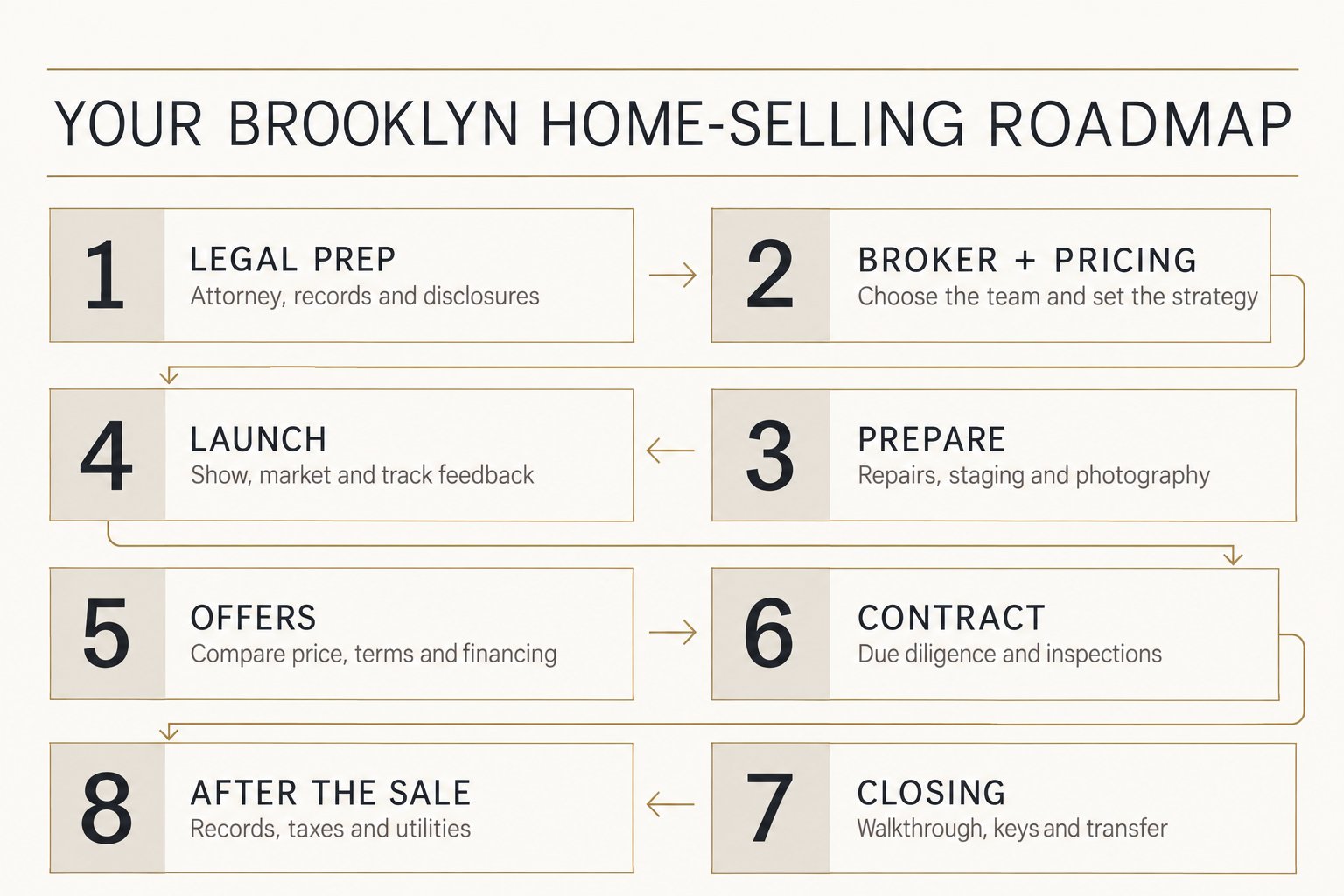
1. Legal and financial preparation
Choose your attorney before you choose your broker. In New York, you need a real estate attorney for any residential sale. Your attorney will review and negotiate the contract, handle the title work, and coordinate the closing. Choose an attorney who does New York residential real estate regularly. Hire them before you sign a listing agreement so they can review it. A listing agreement is a contract with real obligations. The commission rate, the exclusivity period, and the tail provision (the period during which the broker may still be owed commission after the agreement expires) all matter and all can be negotiated. Your attorney should see the listing agreement before you sign it.
Interview at least two brokers. Compare brokers on their pricing analysis, their marketing plan, their commission structure, and their track record in your property type and price range. A broker who has sold 20 brownstones in Park Slope in the last two years knows that market better than a generalist. Ask for ferences from sellers they've represented in the past year, and call them.
Run your own DOB search. For brownstone and townhouse sellers, pull your building's record from the NYC Department of Buildings website (nyc.gov/buildings) before your buyer's attorney does. Open violations will surface in due diligence. Knowing what's there gives you time to address it on your schedule rather than the buyer's. Some violations clear quickly with a contractor's paperwork. Others require contractor work and DOB sign-off that takes months.
Check for open LPC permits. If your property is in a landmark district (Brooklyn Heights, Park Slope Historic District, Cobble Hill, Carroll Gardens, Boerum Hill, Fort Greene/Clinton Hill), any exterior work done without a Landmarks Preservation Commission permit is a potential closing issue. Your attorney should confirm that all LPC permits are closed before you list.
Get a pre-listing appraisal if pricing is uncertain. In estate sales, divorce sales, or situations where the right price is unclear, a certified appraisal establishes fair market value and protects the seller's decision on pricing. The cost is $800 to $1,200 for a residential appraisal in Brooklyn.
Review the certificate of occupancy and confirm it matches the actual use. For a brownstone with rental units, confirm that the building's CO reflects the actual number of residential units and their configuration. If the building has three apartments but the CO reflects two, you have a DOB issue that will come up in due diligence.
2. Pricing your Brooklyn home accurately
Pricing is the single decision that most determines whether your listing succeeds or stalls. Get it right from day one and you attract serious buyers quickly. Price too high, and you accumulate days on the market that become their own problem.
A thorough comparative market analysis looks at properties that actually closed, not properties that are currently listed or that expired without selling. Closed sales are evidence of what buyers actually paid. Listed properties are asking prices. Expired listings are evidence of what buyers were not willing to pay. Your broker should present you with a specific set of recent closed comparables (same property type, similar configuration, similar condition, same neighborhood) and build the pricing recommendation from that data.
Also understand the pricing dynamics around offer deadlines. In a competitive Brooklyn market for well-priced properties, setting a first-showing day and an offer deadline one week out can generate multiple competing offers. This requires pricing slightly below the top of what the market will bear, which makes sellers nervous, but it's a strategy that consistently produces strong outcomes when executed correctly. A property priced to invite competition often closes above its asking price.
3. Preparing the property for listing
Decide on preparation and staging. Walk through the property with your broker and evaluate what to address before listing. Refinish floors that need it. Paint throughout in neutral tones. Clear clutter, reduce furniture, and depersonalize. For more substantial preparation, ask your broker what financing options exist for pre-sale improvements funded against eventual proceeds.
Review the listing before it goes live. Read the listing description carefully. Check all the details: square footage, bedrooms, bathrooms, amenities, tax amounts. Errors in the listing create problems later. Review the property tax figure against your most recent city tax bill.
Confirm the listing photos before they go live. Professional photography is non-negotiable. Review the photos before the listing publishes. The goal is accurate and attractive. A wide-angle photo that makes a 200-square-foot bedroom look like 400 square feet is a photo that sets buyers up for disappointment when they walk in.
Understand the showing feedback process. Ask your broker how they collect and report buyer and agent feedback from showings. Feedback from buyers who walked through and didn't offer is often the most honest signal about what's working and what isn't. You should receive a summary of showing feedback within a few days of each wave of activity.
4. Understanding seasonal timing in Brooklyn
Brooklyn's market has two strong selling seasons: spring (late February through early June) and fall (September through early November). Summer brings reduced buyer activity as families travel and the pace slows. The holiday period from Thanksgiving through New Year is the slowest stretch of the year.
The best time to list is early in one of those two active windows. A listing that goes live in late February gets the benefit of fresh buyer interest returning to the market after winter. A listing that goes live in late September catches buyers who have returned from summer and are motivated to be in contract before the holidays.
Listing in August or in December is a choice many sellers make out of necessity, and those listings can absolutely sell, but they do so with a smaller buyer pool and often a longer time on market. If you have flexibility on timing, consult with your broker about the specific conditions in your neighborhood and price range. A $3M brownstone in Brooklyn Heights may sell well in August if inventory is thin. A $900,000 condo in Prospect Heights in December may sit until January.
5. Offers and negotiation
Evaluate every offer completely before responding. The highest offer is not automatically the best offer. Evaluate price, financing (cash versus mortgage, pre-approval strength), contingencies (inspection, financing), proposed closing date, and any personal property inclusions. A lower all-cash offer with no contingencies may net you more with less risk than a higher financed offer with multiple contingencies.
Don't act on a verbal offer. In New York, offers are verbal and unenforceable until both parties sign a contract. Nothing is binding until contracts are signed. Move quickly to contracts once you've accepted an offer. The typical timeline in Brooklyn is contracts sent within two to three business days of accepted offer, signed within five to ten business days after that.
Give your attorney the deal terms immediately. As soon as you've accepted an offer in principle, communicate the terms to your attorney so they can begin drafting the contract. The faster both sides get to a signed contract, the less exposure you have to the deal falling apart between verbal acceptance and contract execution.
6. Contract to closing
Complete the Property Condition Disclosure Statement accurately. For one-to-four-family residential properties, New York requires sellers to disclose known material defects. Complete this form accurately. Misrepresentation creates liability that survives closing.
Keep the property in the same condition as during showings. Don't remove fixtures, appliances, or light fixtures that were present during showings unless that was explicitly agreed to in the contract. Changes to the property's condition between contract and closing can give a buyer grounds to renegotiate or walk away.
Respond to buyer's requests promptly. During the due diligence period, buyers and their attorneys will request documents, ask questions, and follow up on inspection items. Prompt responses keep the transaction on schedule. Delays attributable to the seller can give the buyer grounds to extend contingency periods.
Prepare for the closing walkthrough. The buyer has the right to do a final walkthrough of the property shortly before closing to confirm it's in the contracted condition. Make sure the property is clean, all agreed-upon items are present, and any repairs you agreed to make are complete.
7. Closing day
Bring photo ID. You will need government-issued photo ID at closing.
Confirm the wire transfer details with your attorney in advance. Your net proceeds will typically be wired to you at or shortly after closing. Confirm the wire instructions with your attorney by phone, not by email, which is vulnerable to fraud. Any email you receive with wire instructions that differ from what your attorney previously gave you should be treated as a potential fraud attempt and verified immediately.
Leave the property in broom-clean condition. Unless otherwise agreed in the contract, you are responsible for leaving the property in broom-clean condition. Remove all personal property, clean the space, and leave any agreed-upon appliances or fixtures in working condition.
Deliver all keys and access devices. All keys, key fobs, garage openers, and any other access devices should be delivered at closing. If there are building keys, mailbox keys, or storage unit keys, have them ready.
8. After closing: taxes and records
Keep all closing documents. The closing disclosure, the deed, the settlement statement, and your attorney's closing summary should be saved. You'll need them for tax purposes, particularly if you're reporting capital gains or losses. Keep a digital copy in a secure location and a paper copy with your important documents.
File your capital gains information with your CPA. The sale of a Brooklyn property may have federal and state capital gains implications. The federal exclusion allows you to exclude up to $250,000 of gain ($500,000 for married couples) if you've owned and used the property as your primary residence for at least two of the five years before the sale. If you had deductible improvements that increase your basis, document those too: receipts, contractor invoices, and permits for work that qualifies as a capital improvement increase your cost basis and reduce your taxable gain.
Notify the relevant parties of your address change. Cancel your homeowner's insurance for the property immediately after closing. Notify the utility companies of the transfer. If you had any property tax exemptions, confirm whether they need to be canceled and whether the new property you're moving to has different filing requirements.

Fouad Rahmé
Founder, the Rahmé Team at Compass
The Rahmé Team advises buyers, sellers, investors, and developers across Brooklyn, with 40 years of combined experience, more than 1,000 clients and transactions, and over $800 million in career sales. RealTrends Verified ranks the team in the top 1.5% of real estate professionals nationwide.
Contact the team or call (718) 233-3365.
Ready to start the process?
The Rahmé Team walks every seller through this process before the listing goes live, not after problems come up. Call (718) 233-3365 or contact us.
Frequently Asked Questions
How long does it take to sell a home in Brooklyn?
A well-priced property in a desirable Brooklyn neighborhood may have an accepted offer within the first two to four weeks. Accepting an offer is only the first step, however, the attorney review and due-diligence process that follows can be time-intensive and take anywhere from a week to a month or longer. Once the contract is signed, the contract-to-closing period for a financed purchase generally runs 60 to 90 days, while an all-cash deal may close within 30 to 45 days. The biggest variable is usually the listing period: properties priced correctly in strong neighborhoods tend to move quickly, while overpriced listings can sit for months before a price adjustment restores momentum.
What repairs should I make before selling my Brooklyn home?
Focus on things that affect buyer confidence rather than taste. Fix anything that is visibly broken, leaking, or represents deferred maintenance that will show up on an inspection: dripping faucets, broken windows, electrical panels with visible issues, deteriorating roof flashing. Paint is almost always worth doing in neutral tones. Full kitchen and bathroom renovations rarely return their cost at sale. Your broker should walk through the property and help you prioritize what moves the needle versus what's money without return.
When is the best time of year to list a Brooklyn home?
Spring, specifically late February through May, is historically the most active period for Brooklyn real estate and typically produces the most competitive offers. The fall market, September through November, is the second-strongest window. Summer listings face reduced buyer activity as families travel, and January listings compete with a thinner buyer pool. That said, a well-priced home in Brooklyn will sell in any month. Timing matters at the margin, but pricing and presentation matter more.
How far in advance should I start preparing to sell?
Ideally, three to six months before you want to list. That runway gives you time to address any permit or violation issues, complete minor repairs, have a staging consultation, gather any required building documents, and work with your broker on pricing strategy. Sellers who list without this preparation period often scramble to address issues that slow the transaction or cost them negotiating leverage.
Do I need a real estate attorney to sell in Brooklyn?
Yes. New York is an attorney state for real estate transactions, and the contract is drafted and reviewed by attorneys on both sides. Your attorney will handle the contract of sale, review the title report, coordinate with the buyer's attorney on any contract issues, and represent you at closing. Budget $2,500 to $4,000 for attorney fees on a typical Brooklyn sale. This is not a place to cut costs.