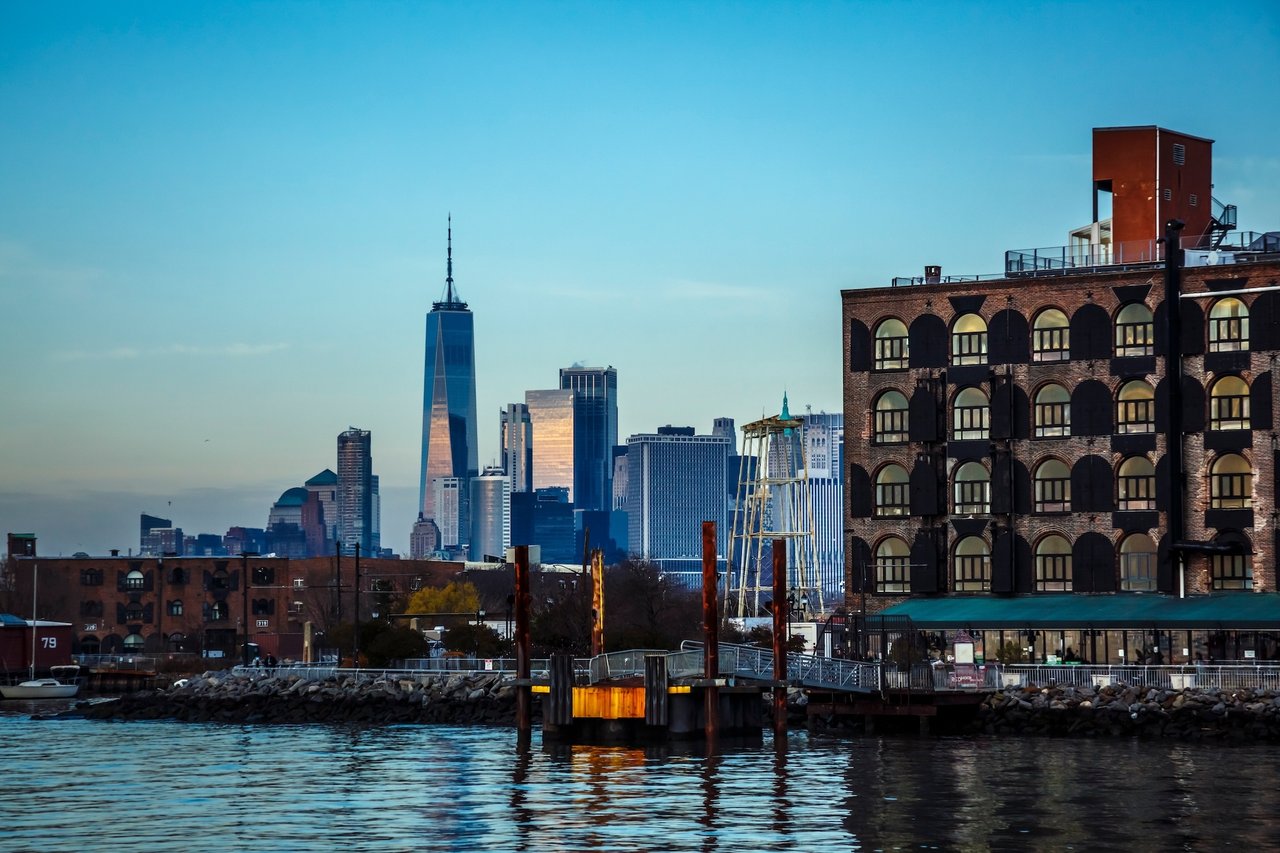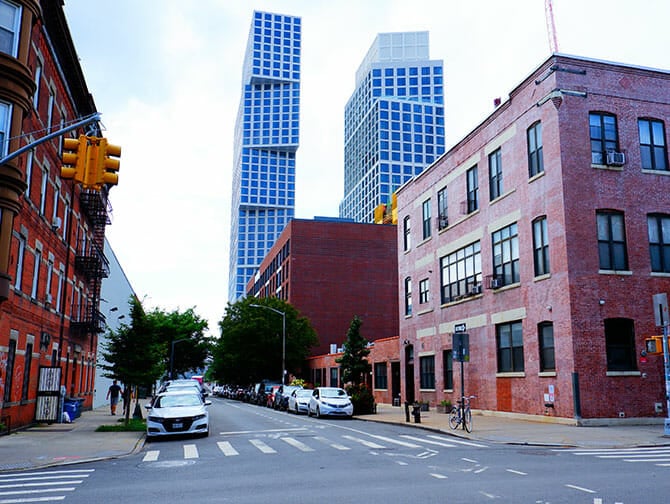
What is Greenpoint like for buyers? It's two neighborhoods wearing one zip code. On the water, a half-mile of glass towers that didn't exist twenty years ago, with skyline views and amenity floors. Three blocks inland, 1850s brick and wood row houses on streets that shipbuilders built, most of it landmarked since 1982. Same neighborhood. Completely different purchases.
Start with the thing most guides get wrong, because it'll save you a month: a lot of that waterfront is rental, not for sale. Greenpoint Landing's delivered buildings skew heavily toward rentals, and the affordable component runs through housing lotteries. Condos on the water exist, and some of them are very good, but the for-sale field up there is narrower than the skyline implies. If you're buying rather than renting, the inland blocks deserve more of your attention than the marketing suggests.
This guide walks both sides honestly: what the 2005 rezoning actually produced, what a landmarked row house asks of an owner, the ferry-versus-G-train question that decides where people end up living, and the environmental diligence this particular waterfront requires and no brochure mentions.
In this guide
- The lay of the land: what defines Greenpoint
- Quick comparison: the four pockets at a glance
- Which pocket is right for you?
- Towers, row houses, and loft conversions: the housing ladder
- The rental question on the waterfront
- The commute, honestly
- What drives value in Greenpoint
- Franklin, Manhattan Avenue, and the esplanade
- The environmental diligence nobody puts in the brochure
- The four pockets, up close
- The Rahmé Team Greenpoint market read
- Buying strategy: how to actually win here
- Living here day to day
- How to choose
- FAQs
- Work with a local team

Fouad Rahmé
Founder, the Rahmé Team at Compass
The Rahmé Team advises buyers, sellers, investors, and developers across Brooklyn, with 40 years of combined experience, more than 1,000 clients and transactions, and over $800 million in career sales, $167 million of it since 2020. RealTrends Verified ranks the team in the top 1.5% of real estate professionals nationwide.
Contact the team or call (718) 233-3365.
The lay of the land: what defines Greenpoint
Geography first, because it explains everything else. Greenpoint is the northern tip of Brooklyn, bounded by Newtown Creek and Queens to the north, the East River to the west, Williamsburg to the south, and the Brooklyn-Queens Expressway to the east. It's a peninsula, more or less, and until recently it was a peninsula you had to mean to visit.
The bones are industrial and they're old. Neziah Bliss started buying land here in 1832 and brought shipbuilding with him, and by the 1850s more than a dozen shipbuilding firms had made this the center of the trade in Brooklyn. The row houses in what's now the historic district were built by and for the men working in those yards, which is why they read modest and cohesive rather than grand. Glassmaking, porcelain, and oil refining followed the ships. That industrial century built the housing stock, and it also left the ground conditions we'll get to further down.
The Landmarks Preservation Commission designated the Greenpoint Historic District on September 14, 1982: roughly 43 acres and 363 contributing buildings put up between 1850 and 1900, covering stretches of Java, Franklin, Kent, Milton, Noble, Calyer, Leonard, Oak, Guernsey, and Lorimer Streets along with parts of Greenpoint and Manhattan Avenues. Italianate mostly, three or four stories over a basement, high stoops, round-arched doorways. Then in 2005 the city rezoned 175 blocks of Greenpoint and Williamsburg and the waterfront changed shape entirely. Those two facts, forty years and a few hundred yards apart, are the whole story of this neighborhood's housing market.
Quick comparison: the four pockets at a glance
West Street is roughly the line between the two Greenpoints. Here's the shape of it.
The feel | Housing stock | What's actually for sale | Transit | Best if | |
|---|---|---|---|---|---|
The waterfront | New towers, esplanade, open sky, very little older fabric | High-rise glass, amenity floors, river and skyline views | Thinner than it looks; much of the delivered stock is rental | Ferry at India Street, a walk to the G | You want the view, the amenities, and a boat instead of a train |
The historic district | Kent, Milton, Noble, Java, low and quiet and intact | Italianate brick and wood-frame rows, two to four stories, many multi-family | Whole houses, rarely, plus co-ops and small condos | Walk to Greenpoint Avenue on the G, walk to the ferry | You want a house with rental income and a protected streetscape |
East of Manhattan Avenue | Toward McGuinness and the BQE, more workaday | Row houses and multi-families outside the district, some newer infill | The widest for-sale house inventory in the neighborhood | Nassau Avenue and Greenpoint Avenue on the G | You want renovation latitude and more house for the money |
The southern end | Toward McCarren Park and the Williamsburg line | Loft conversions, boutique condos, mixed older stock | Condos, and the most turnover of any pocket | Nassau Avenue, plus the L a short walk south | You want loft space and two subway lines within reach |
Which pocket is right for you?
It comes down to one thing: are you buying a view or a building? If it's the view, you're shopping the waterfront, and you should start by finding out which towers actually have units for sale rather than assuming they all do. What you get is glass, amenities, a doorman, the esplanade at your feet, and a ferry landing you can walk to in a few minutes. What you take on is common charges, a tax situation that depends entirely on the specific building's abatement, and a five-minute walk to the nearest train.
If it's a building, in the older sense, look inland. The historic district holds two-to-four story rows where an owner's duplex over a garden rental is the standard configuration, and the blocks east of Manhattan Avenue hold similar houses outside the district with more freedom to change them. Those are different investments from a tower unit, with different carrying costs and a completely different resale pool, and for a lot of buyers they're the better one.
Towers, row houses, and loft conversions: the housing ladder
The towers are the newest layer and the most visible. Greenpoint Landing alone covers 22 acres along roughly a half-mile of East River frontage, with about 5,500 apartments planned across eleven projects, roughly 1,400 of them affordable, plus about five acres of public open space. The first affordable building broke ground in 2014 and the first market-rate tower opened in 2018, and by the middle of 2025 nine parcels holding around 3,000 apartments had been delivered. Buildings elsewhere on the water fill in around it. The product is what you'd expect: floor-to-ceiling glass, high floors with real views, package rooms, fitness, roof decks, and a shoreline built to current standards rather than 1890s ones.
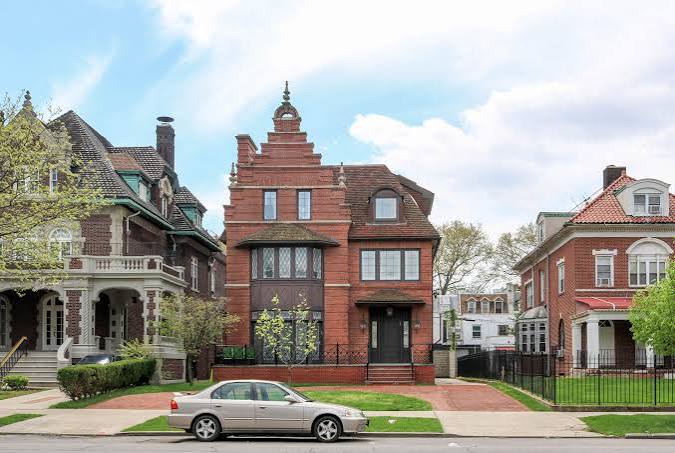
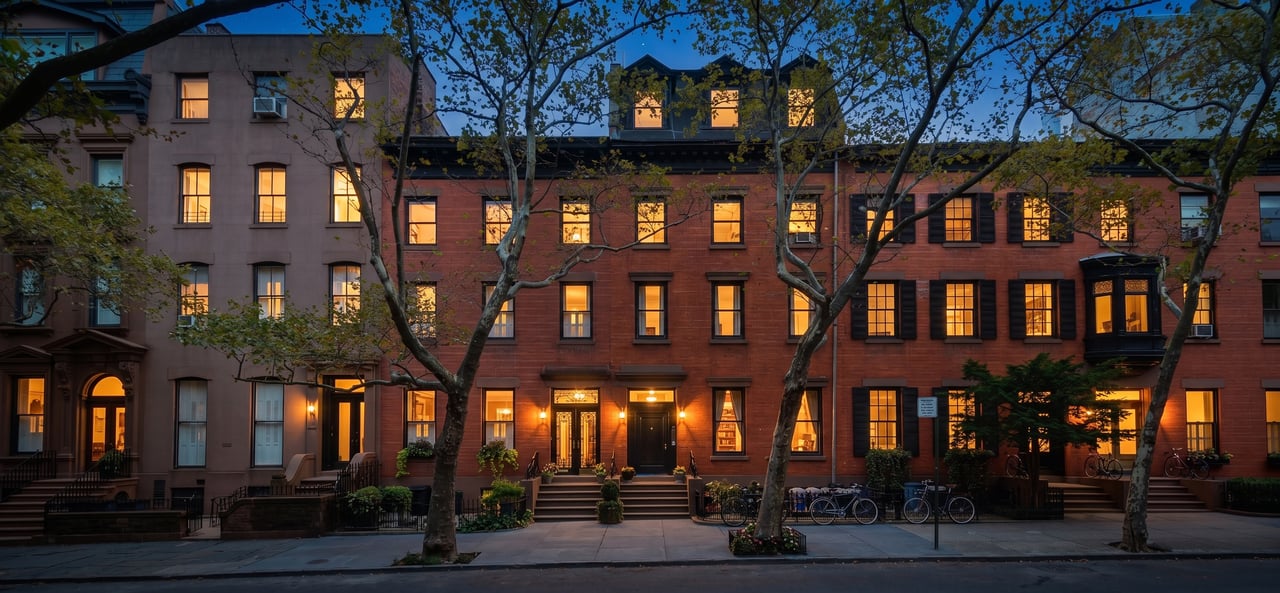
The row houses are the oldest layer and the reason people fall for the neighborhood. Italianate brick and wood frame, three or four stories over a basement, high stoops, round-arched doorways, tin ceilings and pocket doors inside where they survived. Most were built as multi-family or converted early, so the income configurations here are real: two- and three-families are common, and an owner's floor over a rental is the default way people buy in. The Astral Apartments on Franklin, a landmarked model tenement built for oil refinery workers, is worth walking past just to see what nineteenth-century workforce housing looked like when somebody cared.
Between them sit the conversions. Old warehouse and manufacturing buildings turned into lofts and boutique condos, mostly toward the southern end and the inland industrial pockets, with the high ceilings and column grids you'd expect. These are often the sweet spot for buyers who want space and character without a whole building's worth of maintenance, and they trade often enough to read clearly.
The rental question on the waterfront
This deserves its own section because it changes how you should spend your Saturdays. The waterfront redevelopment here produced a great deal of rental housing and comparatively less for-sale housing. Several of the marquee towers are rental buildings. A meaningful share of the affordable units are lottery rentals run through the city's housing portal. Condominium buildings do exist on and near the water, and some of them are excellent, but the for-sale inventory is a subset of what you see from the esplanade, not the whole skyline.
Two practical consequences. First, if a tower comes up in conversation, confirm whether it's a condo before you fall for a floor plan; asking that question first has saved our buyers real time. Second, the rental depth up there supports a genuine investor case on the inland multi-families, because the tenant pool is deep and visible and it isn't going anywhere. Those two facts point in opposite directions for different buyers, which is exactly why the neighborhood rewards a plan.
The commute, honestly
The G is the only subway line that serves Greenpoint, at Greenpoint Avenue and Nassau Avenue, and it's the only line in the entire system that never enters Manhattan. It runs Court Square in Long Island City down to Church Avenue in Kensington. To get to Manhattan you transfer, typically at Court Square for the E, M, or 7, or south at Metropolitan and Lorimer for the L. Greenpoint Avenue is ADA-accessible. Signal modernization work on the line has been ongoing, which has meant service disruptions along the way and better headways coming out the other side.
The ferry is the reason a lot of people choose the waterfront. NYC Ferry's East River route stops at the India Street landing, and it's a one-seat ride to Manhattan with a view the whole way, at the same fare as the subway. The honest caveats: it runs on a schedule rather than a frequency, weather matters, and NYC Ferry restructured its network in December 2025, so check the current route map rather than an old blog post before you weight it heavily in a decision.
Everything else is bikes, buses, and McGuinness Boulevard. Cycling here is very good and a lot of people commute on two wheels most of the year. McGuinness cuts north to south through the middle of the neighborhood, carries real traffic, and has been the subject of a long-running and contested city redesign, so if you're looking at a block near it, ask what the current plan is.
What drives value in Greenpoint
On the water, the building is the purchase. Floor, exposure, and view do the obvious pricing, but what actually separates two similar units is the financial package underneath: common charges, reserve health, and the tax abatement status. Abatements on new construction phase out on a schedule, and a unit's monthly cost five years from now can look very different from today's. Ask what the abatement is, when it steps down, and what the taxes look like on the other side. That single question moves more money than the kitchen finishes do.
Inland, the house is the purchase and the paperwork is the house. Legal use and unit count first: many of these buildings are two- or three-family by right and some conversions were never legalized, so the Certificate of Occupancy needs to match what's being marketed before you underwrite any rent. Then condition, because nineteenth-century brick and wood frame carry the maintenance profile you'd expect. Then the district line, since exterior work inside the historic district answers to the Landmarks Preservation Commission and outside it answers to the Department of Buildings.
Across both, proximity works differently here than in most of Brooklyn. Being close to the G matters less than being close to whichever transit you'll actually use, and a waterfront address that's a ten-minute walk from a train can still be the faster commute if the ferry schedule suits you. Buyers who map their own actual routes, rather than the theoretical one, end up in better apartments.
Franklin, Manhattan Avenue, and the esplanade
Franklin Street is the low-key spine, running north to south along the western side with the coffee, the small restaurants, the bookshop, and the storefronts in old row-house ground floors. It's the street people mean when they say Greenpoint feels like a small town, and it's a short walk from most of the historic district.
Manhattan Avenue is the working corridor and it's busier, wider, and more useful. Bakeries, butchers, delis, pharmacies, hardware, and the everyday retail that's been operating on that street for generations, alongside newer places filling in. It's where the neighborhood actually shops, and it runs directly to the Greenpoint Avenue subway entrance.
The waterfront is the newest and most contested amenity. The 2005 rezoning requires new development to build and fund public open space, which is producing an esplanade in stages: some of it open and excellent, some of it still fenced, and a fully continuous walk from Newtown Creek down to Williamsburg still some years out. WNYC Transmitter Park is the one to see, with a pier that puts the Manhattan skyline directly in front of you, and Newtown Barge Playground sits beside the newer esplanade sections. McCarren Park anchors the southern border and does the heavy lifting for actual green space, since the waterfront parks are still filling in.
The environmental diligence nobody puts in the brochure
Here's the part that belongs in a buying guide and shows up in almost none of them. Greenpoint's industrial century left real ground conditions, and there are two federal Superfund sites in or adjacent to the neighborhood: Newtown Creek, along the northern border, and the Meeker Avenue Plume, a groundwater contamination site on the eastern side. The neighborhood also sits over the Greenpoint oil spill, one of the largest in United States history, from decades of refinery operations. Remediation on all of it is ongoing and long-running.
What this means for a buyer is not panic. It means a specific set of questions. Check whether a given address sits within a designated remediation area, ask about vapor intrusion mitigation on any new construction built over a former industrial site, and read the environmental disclosures in an offering plan rather than skimming them. Newer buildings on the waterfront were built under current environmental review and often include mitigation systems by design; older buildings on former industrial parcels are the ones worth asking harder questions about.
It also has a market consequence worth naming: environmental review is part of why the waterfront redevelopment has moved in stages over two decades rather than all at once. That's a slower pipeline than the renderings suggest, which cuts both ways for anyone pricing future supply.
The four pockets, up close
The waterfront is the new neighborhood, and it doesn't pretend otherwise. Towers, the esplanade, Newtown Barge Playground, the ferry landing at India Street, and sky in every direction because there's nothing tall around it except itself. Buy here for the view, the amenities, and the boat, and go in knowing which buildings are actually condos.
The historic district is the old neighborhood, and it's the one people photograph. Kent, Milton, Noble, and Java between Franklin and Manhattan Avenue hold rows of Italianate houses built for shipyard workers, protected since 1982, with the churches and the two old bank buildings anchoring the corners. Whole houses come up rarely. When they do, they tend to sell to buyers who'd been watching the block.
East of Manhattan Avenue, toward McGuinness and the BQE, the streets get more workaday and the inventory gets deeper. Similar houses outside the district's exterior rules, more infill, more two- and three-families in a range of conditions, and better value per square foot. This is where the income-property math usually pencils best, and where buyers who started on the water often end up.
The southern end, running toward McCarren Park and the Williamsburg boundary, is the loft-and-conversion pocket. Old industrial buildings turned into condos, more turnover than anywhere else in the neighborhood, and the L train a short walk south, which for some commutes beats the G outright. It's the most liquid inventory in Greenpoint.
The Rahmé Team Greenpoint market read
This market has to be read as at least three separate ones, and any single Greenpoint number blends them into something true of nothing. New-construction condos price off building financials and abatement schedules. Row houses price off legal unit count and condition. Conversions sit in between and trade the most often. On top of that, the waterfront pipeline keeps delivering in stages, which means the supply picture up there is a moving target in a way the inland blocks simply aren't.
For the borough-wide picture, our Brooklyn market report runs the numbers from the closed-sales record and refreshes with each edition. For this neighborhood specifically, call us and we'll pull what actually closed in the category you're shopping, because a Blue Slip high floor and a Noble Street two-family are different purchases sharing one esplanade.
Buying strategy: how to actually win here
On the tower side, the building is the deal. Read the offering plan properly, and read the financials with the same attention you'd give the floor plan: common charges, reserve fund, any special assessment history, and above all the tax abatement, what it saves you now and what the step-down schedule does to your monthly cost later. Ask about the sponsor's remaining unsold inventory too, since that affects both the board and your resale competition. Abatements have their own rules and their own timelines and they're worth understanding in detail before you sign anything.
On the house side, the paperwork is the deal. Certificate of Occupancy against actual use, because rent you can't legally collect isn't income. Historic district status, because it decides your renovation path. Then the physical diligence the era demands: roof, masonry or frame depending on which you're buying, party walls, cellar moisture, and the age of every system. Add the environmental questions above for anything on or near a former industrial parcel.
And on both sides, map your real commute before you commit. Walk from the actual address to the actual train, then to the actual ferry landing, at the actual hour you'd be doing it. This is a neighborhood where that ten-minute difference decides whether people love where they live, and it's free to check. That's the work we do for buyers here. Start it through our contact form or calibrate against the current listings, and tell us whether you're shopping the water or the blocks.
Living here day to day
Mornings split by which way you're headed. The ferry crowd walks down to India Street and gets the skyline with their coffee. The G crowd heads for Greenpoint Avenue or Nassau Avenue and the transfer at Court Square. And a surprising number of people just get on a bike, because the ride into Williamsburg or over toward Long Island City is short and flat.
Days run on Franklin and Manhattan Avenue, which cover most of what a household needs without leaving the peninsula, and evenings run on the same two streets. Weekends belong to McCarren Park, Transmitter Park's pier, and whatever section of the esplanade is currently open, which is a running joke and a real amenity at the same time. Sunset from the Transmitter Park pier is the single best free thing in the neighborhood.
The fine print is short. One subway line, and it doesn't go to Manhattan. Ferry service that's excellent when it's running and schedule-dependent when it isn't. McGuinness traffic. Ground conditions that require real diligence. Waterfront parks still arriving in pieces. And on the school question, zoning runs by address and varies, so treat the Department of Education's school search as the only answer that counts for any specific home; worth knowing that the city is building a new elementary school at 257 Franklin Street, because three nearby elementary schools built in 1900 or earlier are at or approaching capacity. None of that is a secret, and you can see all of it in a single afternoon that ends on the Transmitter Park pier.
How to choose
Lead with the thing you won't trade away and the search narrows quickly.
If this is the priority | Start here |
|---|---|
A skyline view and an amenity building | The waterfront condos, confirming which buildings are for sale first |
Rental income under your own roof | Two- and three-family houses east of Manhattan Avenue |
A protected streetscape and original detail | Kent, Milton, Noble, and Java inside the historic district |
Loft space and open plans | The conversions at the southern end toward McCarren Park |
A one-seat ride to Manhattan | Anything within a short walk of the India Street ferry landing |
Two subway options | The southern blocks, within walking distance of the L |
FAQs
What is Greenpoint like for buyers?
It's two housing markets in one neighborhood. On the East River, towers built since the 2005 rezoning give you glass, skyline views, amenity packages, and a ferry landing at India Street. Three blocks inland, the Greenpoint Historic District holds 1850s Italianate row houses built for shipbuilding workers, protected since 1982, most of them multi-family. The trade-offs differ by side: towers carry common charges and abatement schedules that step down over time, houses carry nineteenth-century maintenance and legal-use questions, and the whole neighborhood is served by one subway line that doesn't enter Manhattan.
Are Greenpoint's waterfront towers condos or rentals?
A lot of them are rentals, and this is the most common surprise buyers hit here. Greenpoint Landing's delivered buildings skew heavily toward rental, and a significant affordable component runs through city housing lotteries rather than sales. Condominium buildings do exist on and near the waterfront, and some are excellent, but the for-sale field is a subset of the skyline rather than the whole of it. Confirm a building's ownership structure before you invest a weekend in it.
Is the G train enough for commuting from Greenpoint?
For a lot of people, yes, with a transfer built into the plan. The G serves Greenpoint Avenue and Nassau Avenue at all times, and it's the only line in the system that never enters Manhattan, running Court Square down to Church Avenue. Manhattan trips mean transferring, usually at Court Square for the E, M, or 7, or at Metropolitan and Lorimer for the L. Signal modernization work on the line has caused disruptions and is aimed at better frequency. If a one-seat ride matters to you, the ferry is the answer rather than the subway.
How does the Greenpoint ferry work?
NYC Ferry's East River route stops at the India Street landing on the northern waterfront, giving a one-seat ride to Manhattan at the same fare as a subway swipe, with the skyline in the window the whole way. Two caveats worth respecting: it runs on a published schedule rather than turn-up-and-go frequency, and NYC Ferry restructured its network in December 2025, so check the current route map before you factor it into a purchase. Weather and service changes affect it more than they affect a train.
Are there environmental issues buyers should know about in Greenpoint?
Yes, and they're worth understanding rather than fearing. The neighborhood borders or contains two federal Superfund sites, Newtown Creek and the Meeker Avenue Plume, and sits over the Greenpoint oil spill, one of the largest in United States history, a legacy of a century of refining and manufacturing. Remediation is long-running. For a buyer, that translates into specific diligence: check whether an address falls in a designated remediation area, ask about vapor intrusion mitigation on construction over former industrial land, and read the environmental sections of any offering plan properly rather than skimming them.
What does a historic district designation mean for a Greenpoint row house?
Inside the Greenpoint Historic District, designated September 14, 1982 and covering roughly 363 buildings built between 1850 and 1900, exterior work visible from the street needs Landmarks Preservation Commission approval, which covers windows, facades, roofs, stoops, and additions. Outside the district, exterior work answers to the Department of Buildings instead. The district's boundaries run along stretches of Java, Franklin, Kent, Milton, Noble, Calyer, Leonard, Oak, Guernsey, and Lorimer Streets plus parts of Greenpoint and Manhattan Avenues, so two similar houses a block apart can have different rulebooks. Confirm the specific address.
Is Greenpoint less expensive than Williamsburg?
Generally yes for comparable product, though the gap has narrowed considerably as the waterfront filled in, and it varies more by building type than by neighborhood line. The more useful comparison is what you're buying: Greenpoint's row-house stock is lower, older, and more intact than most of Williamsburg's, and its tower market is newer and more concentrated. Rather than quote a spread that ages out within a quarter, we'll pull what actually closed in the category you're shopping on both sides of the line.
How do school zones work in Greenpoint?
Zoning runs by address and varies, so verify any specific home through the Department of Education's school search before you write an offer and treat a listing's zone claim as a starting point to check. One piece of factual context worth knowing: the city is building a new elementary school at 257 Franklin Street, because three nearby elementary schools built in 1900 or earlier are at or approaching capacity as the waterfront population has grown. Between zoned options, charters, and citywide programs, the DOE lookup rather than any paragraph should carry that decision.
Comparing north Brooklyn's waterfronts? Our Williamsburg guide covers the neighborhood directly south, the DUMBO guide walks the borough's other converted-warehouse-and-tower market, and the neighborhood page for Williamsburg holds the current inventory picture next door.
Work with a local team
Greenpoint rewards buyers who read offering plans and Certificates of Occupancy as carefully as floor plans, and in a neighborhood where the abatement schedule on one side and the legal unit count on the other decide the real cost of ownership, that reading is most of the job. The Rahmé Team at Compass brings 40 years of combined experience across Brooklyn, ranks in the top 1.5% of real estate professionals nationwide by RealTrends Verified, and has closed more than $800 million in career sales. We work with buyers, sellers, and developers on new-development analysis, historic district and multi-family diligence, environmental questions on former industrial parcels, and the off-market conversations the row-house market here actually runs on.
Ready to see both sides of the peninsula properly? Start with our Greenpoint neighborhood page, then call the Rahmé Team at (718) 233-3365 or request a neighborhood inventory list through our contact form, built around the water, the train, and your actual budget.